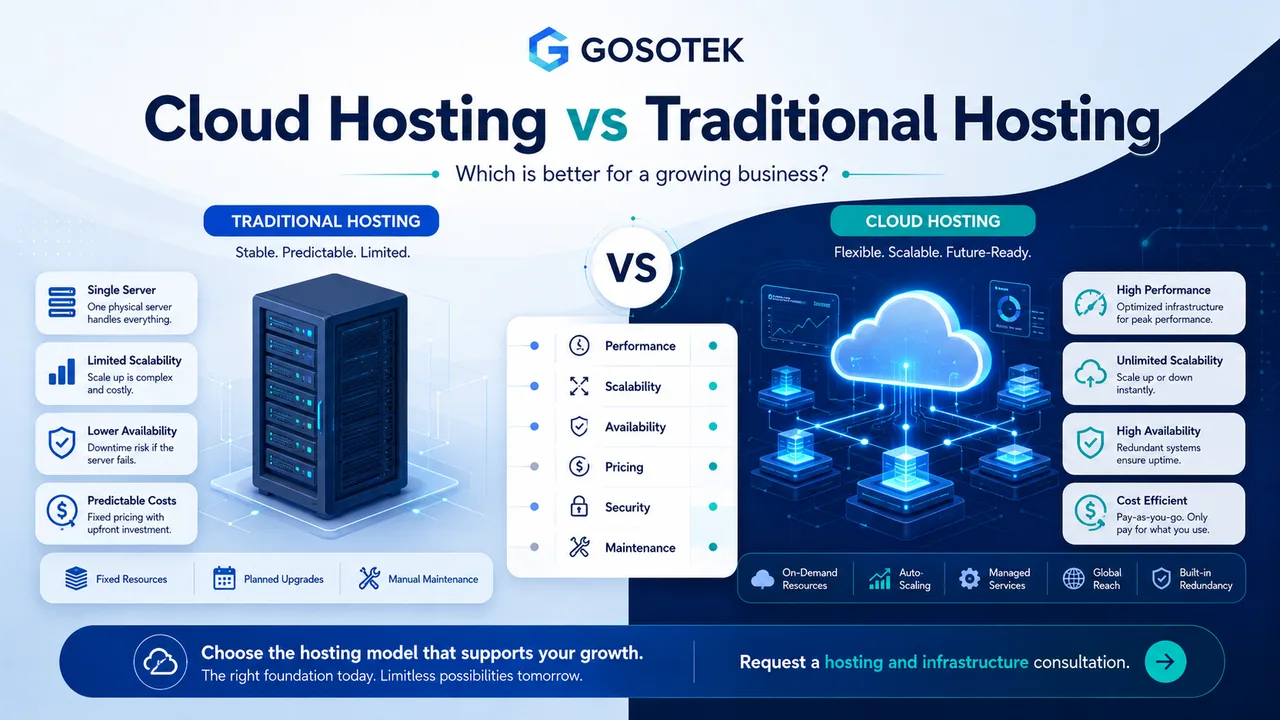
A hosting plan that supports a small website can become a bottleneck when traffic, transactions or internal users grow. The choice depends on performance, uptime, cost control and future resource needs.
The Direct Answer
Cloud hosting usually suits businesses expecting changing traffic, new applications or expansion. Traditional hosting can still suit stable workloads that need a simple, fixed environment.
Cloud hosting runs websites and applications on virtual resources across a provider’s infrastructure. Traditional hosting generally depends on a shared, VPS or dedicated server.
| Factor | Cloud hosting | Traditional hosting |
|---|---|---|
| Performance | Can distribute traffic across resources | Limited by the selected server |
| Scalability | Resources can expand or reduce quickly | Upgrades may require manual migration |
| Availability | Supports redundancy, backups and failover | Often depends on one server or location |
| Pricing | Flexible, usage-based billing | Predictable fixed charges |
| Maintenance | Provider manages physical infrastructure | More server management may remain with the customer |
| Best fit | E-commerce, SaaS, apps and variable traffic | Small sites and stable legacy systems |
Performance, Scalability and Availability
Traditional hosting can perform well when demand stays within its limits. Problems appear when a campaign, seasonal sale or growing customer base creates a traffic spike.
Cloud infrastructure can use load balancing and automated scaling to respond to demand. However, moving to the cloud does not automatically fix slow code, oversized databases or unoptimized media.
Availability also depends on design. A cloud workload can run across multiple zones with backups and failover. A single cloud server without redundancy can still fail like any other server. Cloud autoscaling services can add or remove capacity according to demand and distribute workloads across availability zones.
Pricing and Resource Allocation
Traditional hosting is easier to budget because the fee is usually fixed. The disadvantage is paying for unused capacity or discovering that the selected plan cannot handle growth.
Cloud pricing is generally based on consumption. It can reduce upfront infrastructure costs, but bills may increase when teams leave idle servers running, retain unnecessary storage or ignore data-transfer charges. Budgets, alerts and regular rightsizing are essential. AWS, for example, provides pay-as-you-go pricing alongside commitment-based options for predictable usage.
Security and Maintenance
Cloud platforms provide tools for identity management, encryption, network protection, logging and monitoring.
Security remains a shared responsibility. The provider protects the underlying cloud infrastructure, while the customer must configure applications, accounts, permissions and data correctly.
Traditional hosting may feel simpler, but patching, backups and disaster recovery can require more internal effort.
Which Option Fits Your Business?
Choose cloud hosting for:
E-commerce websites with seasonal traffic.
Mobile-app backends and customer portals.
SaaS products and multi-location operations.
Systems needing stronger recovery and expansion options.
Traditional hosting may suit a brochure website, low-traffic business or stable legacy system.
A Common Mistake
Do not choose cloud hosting only because it sounds modern. Define expected traffic, uptime, data sensitivity, technical skills and monthly budget first.
The Gosotek Perspective
The real decision is not simply cloud versus server. Gosotek evaluates workload, risk and growth, then recommends the simplest reliable architecture.
FAQs
Is cloud hosting always faster?
No. Infrastructure helps, but application code, database design, caching and media optimization still affect speed.
Is traditional hosting cheaper?
It can be for small, predictable workloads. Cloud may offer better value when demand changes or high availability is required.
Can an existing website move to cloud hosting?
Yes. The plan depends on its technology, integrations and acceptable downtime.
Is cloud hosting secure for business data?
Yes, when identity, encryption, backups, monitoring and access policies are configured correctly.
Conclusion
Cloud hosting gives growing businesses more flexibility and resilience. Traditional hosting remains practical when requirements are simple and predictable.