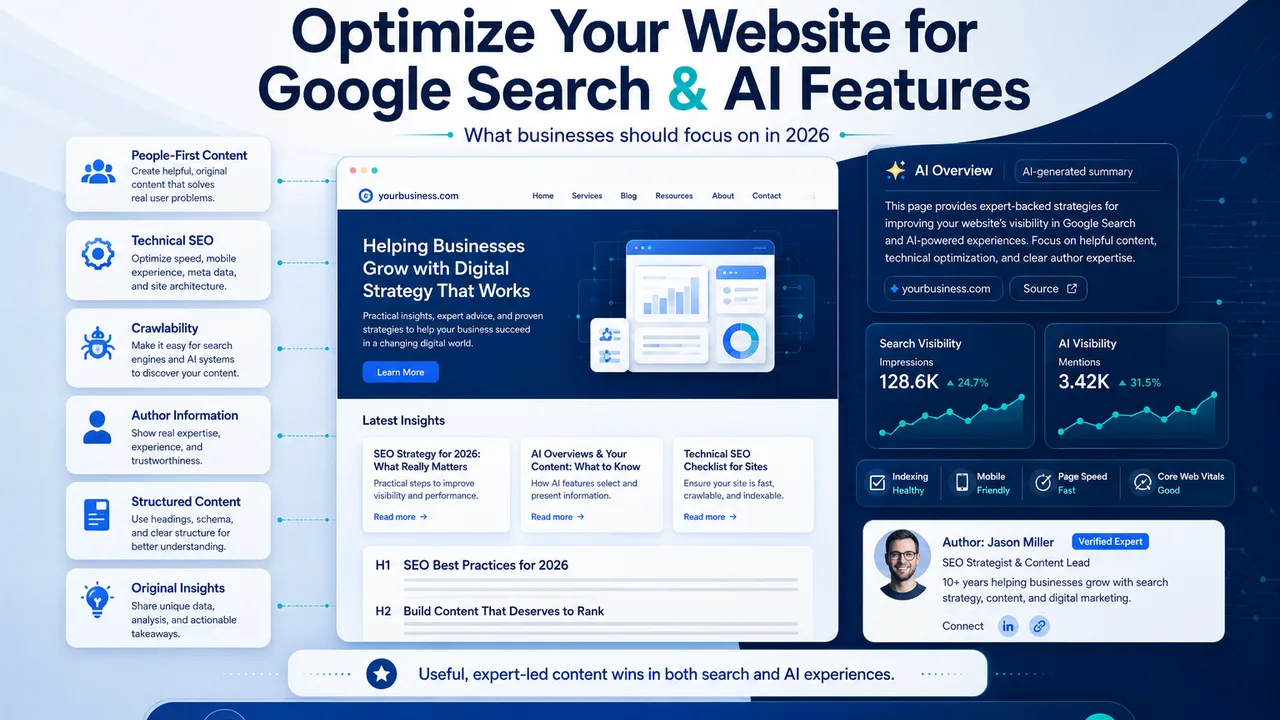
Search behaviour is changing, but the foundation of website visibility has not been replaced. Businesses do not need artificial “AEO” or “GEO” tricks. They need useful pages that search systems can access, understand and confidently present to people.
In 2026, the strongest approach remains straightforward: publish original expertise, maintain sound technical SEO and make every important page genuinely useful to the customer.
Start With People-First Content
A page should solve a real customer problem better than existing alternatives. Instead of publishing another general article such as “10 Digital Marketing Tips,” explain how your team handled a specific challenge, what options were considered and what customers should check before making a decision.
Project examples and lessons learned
Original photographs or demonstrations
Pricing factors and operational constraints
Mistakes observed during client work
Recommendations based on experience
Unique, expert-led content is more valuable than material that simply repeats what already exists online.
Make Expertise and Responsibility Visible
Readers should understand who created the content and why that person or organization is qualified to discuss the subject. Add author names, short biographies, relevant experience and links to detailed profile pages.
Business websites should also maintain accurate About, Contact and Service pages. Author and profile structured data can help search systems understand the people or organizations behind published content, but the markup must match information visible on the page.
Fix Technical SEO and Crawlability
Strong content cannot perform if search systems cannot access it. Check that important pages:
Return a successful status code
Are not accidentally blocked by robots.txt or noindex
Use crawlable internal links
Appear in the XML sitemap
Work properly on mobile devices
Do not hide content behind broken scripts
Use Clear Structure, Not Artificial AI Formatting
Use descriptive headings, short paragraphs, tables and FAQs when they genuinely help readers. There is no requirement to divide every answer into tiny “AI-friendly” sections, and there is no special schema that guarantees visibility in generative search experiences.
Structured data remains useful for clarifying page meaning and supporting eligible rich results, but it should reflect the visible page accurately.
Add Original Business Insight
The strongest content often comes from information competitors cannot easily copy:
Implementation decisions
Support questions
Anonymized project patterns
Regional market knowledge
Practical trade-offs
For example, a software company should not publish only “Benefits of Custom Software.” A stronger article would explain when a growing distributor should continue using spreadsheets and when operational complexity justifies custom software.
Common Mistakes to Avoid
Avoid mass-producing similar articles, making unsupported claims, hiding authorship, targeting every possible keyword variation or rewriting pages solely to appear in AI-generated answers. These tactics create content volume without increasing usefulness.
Frequently Asked Questions
Is AEO or GEO different from SEO?
For practical website optimization, visibility in generative search should be treated as an extension of core SEO rather than a separate shortcut-based discipline.
Does structured data guarantee AI visibility?
No. It can clarify page meaning and support rich-result eligibility, but it does not guarantee inclusion.
Should businesses use AI-generated content?
AI tools may assist production, but the final content should be accurate, original, useful and supported by genuine expertise.
How important is technical SEO?
It is essential because inaccessible or non-indexable pages cannot compete effectively in search.
Conclusion
In 2026, search visibility depends on a clear combination: original expertise, accessible technology, credible authorship and content built around genuine customer needs.